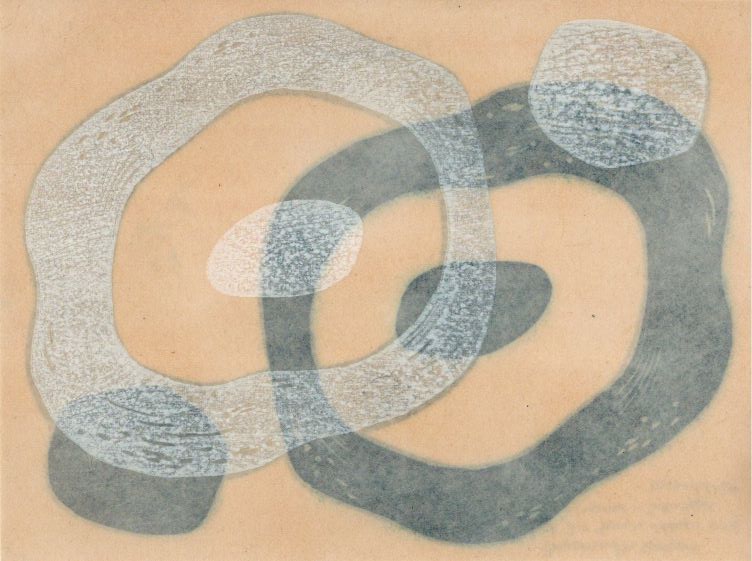
A mokuhanga print using the ‘taku-zuri’ technique (rubbing print) and ‘goma-zuri’ on Pansion K155 with two sheets of Yanase Washi gampi overlaid and mounted on the Pansion and waxed to give a semi transluscent effect. The print uses three blocks of wood and three colours of pigment including watercolour and gouache, and 6 passes of colour. This is one of several prints created whilst on the artist in residency basic training programme at MI-LAB, Echizen in November 2024.
Edition size: Unique
Image size: 190 x 255 mm
Paper size: 190 x 255 mm
Price: NFS
One of our instructors at MI-LAB was Asuka Tsutsumi who has developed the ‘taku-zuri’ technique (rubbing print) for a own highly colourful and innovative work. Asuka-san was very fortunate to have been a student of the well known experimental mokuhanga artist Akira Kurasaki and has taken some of the techniques he developed and adapted them for her own work. She demonstrated how she manipulated her own highly colourful photos by overlaying pigment ink prints with very thin sheets of printed gampi or mino washi and then finished the process with a layer of wax that enhanced the translucency of the thin washi paper and the designs printed on them to create a highly vibrant and almost three dimensional effects.
My print explores this technique using a base layer of Pansion printed with a blue pigment using the ura-zuri technique explained here for my Inyō print. I then printed part of the design on a sheet of gampi in white pigment and part in black on another sheet. These were overlaid and mounted on the front face of the Pansion paper, first the black print and then the white print using a thin layer of nori. Once dried a thin layer of melted paraffin wax was applied to the top surface and then pressed (or rubbed) into the layers of paper using a warm iron (the print is protected by a layer of copy paper whilst doing this which helps to remove the surplus wax). The wax saturates the paper bringing out the beautiful colour of the gampi and enhances the translucency of the prints layered below. The effect is quite stunning, both emphasising the qualities of the thin gampi paper but also the goma-zuri technique and, as Asuka-san’s work demonstrates, can be used to create very striking effects.
 Kay A Brown