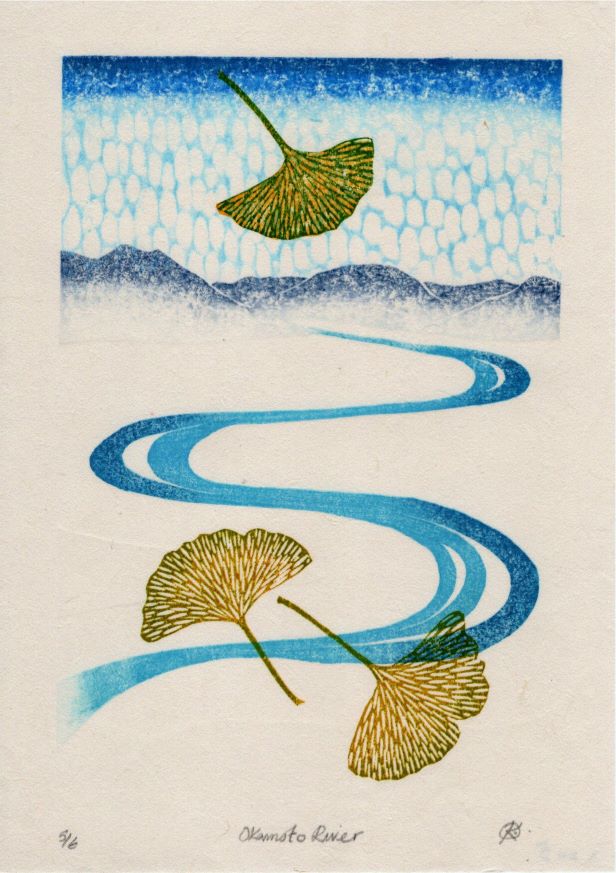
A mokuhanga print on sized Kumohada Mashi (kozo / hemp) washi from the Iwano Heizaburou washi mill in Echizen, Japan. The print was created using four blocks and five colours of pigment including watercolour and gouache, and 14 passes of colour. This one of several prints created whilst on the artist in residency basic training programme at MI-LAB, Echizen in November 2024.
Edition size: 6 no. plus 1 no. artist’s proof
Image size: 170 x 255 mm
Paper size: 210 x 295 mm approx
Price: £100
Echizen lies at the foot of a mountain range close to the northern coast of Japan’s largest island Honshu, about two and a half hours by train north of Kyoto. It has been an important location for the making of washi ( Japanese paper) for over 1500 years, at times with over 100 washi manufacturing mills at the height of production. Legend has it that a beautiful Korean woman came down from the mountains and taught the locals how to make paper, and with a plentiful supply of good quality mountain water from the River Okamoto, this gave them a means to earn a living in the cold winter months when growing rice was not possible. She became known as Kawakami Gozen (the ‘upriver’ paper goddess) and a beautiful shrine, the Okamoto Otaki Shrine, was built and dedicated to her, the only one in Japan, and where festivals have been held for over 1300 years.
Now this industry is in decline with only around 50 mills remaining in the Echizen Washi Village, however Echizen washi is held in high esteem and there is still a lot of enthusiasm for it with initiatives to revitalise the industry and a number of mills are now being run by young people bringing innovation and fresh ideas. There are three museums dedicated to washi located in the washi village, including one where you can try your hand at making washi using traditional methods.
This print is inspired by the beautiful mountains that frame the brilliant sparkling blue skies of Echizen and the morning ‘unkai’ cloud sea that fills the valleys. The entrance to the Okamoto Otaki Shrine is marked by a large red torii (gateway) and two towering Gingko trees which during the autumn are a mass of glorious acidic yellow and gold as the cooler weather forces them to shed their leaves.
Two prints of the edition have been donated to MI_LAB for their archive and will be shown at an exhibition at the Udatsu Museum in December 2024, along with 27 students who attended residencies in this first year in Echizen.
 Kay A Brown