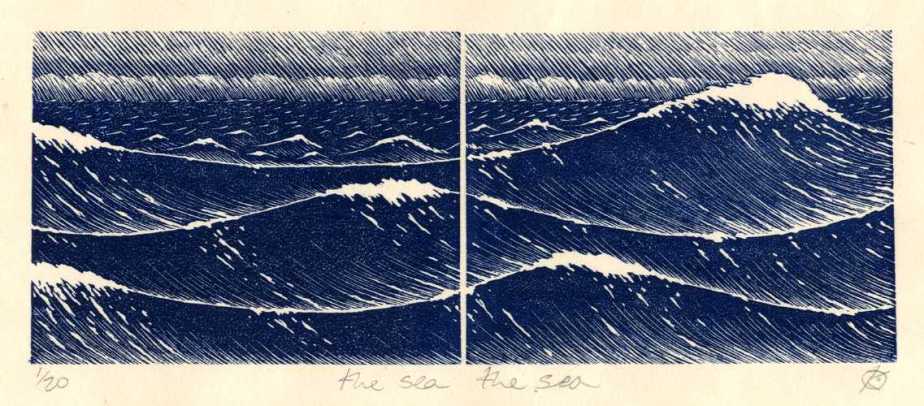
A diptych wood engraving on Lemonwood, hand burnished on 36 gsm Kitakata SH-16 Japanese paper with deckle edges using Cranfield Traditional Relief Ink.
Edition size: 20 (plus 2 no. artist’s proof)
Image size: 180 x 70 mm
Paper size: 215 x 130 mm approx.
Price: £100 (sold unmounted)
Selected for the 89th Annual Exhibition of the Society of Wood Engravers, which tours the country starting at Bankside Gallery on 2 February 2027. This wood engraving continues my exploration of the sea using two almost identical blocks printed side by side as a diptych (and hence a diptych print title – and nothing to do with Iris Murdoch’s novel!). This is the first print that I have made in this format and negates the need for one long block to create a long landscape engraving, something I wanted to do to illustrate a sequence of waves rising, breaking and falling, an image of the wild seas that we experienced sailing off western Ireland in 2025, that never fails to leave me.
Long blocks are problematic as they are expensive, due to the extra work required in gluing several blocks together. Extra care is required as they are prone to cracking or warping making them difficult to print from. So using a diptych arrangement enabled me to achieve my objective without requiring a long block. The two blocks were taped together for engraving to ensure consistency of mark making across each block. I then locked them into a letterpress chase with a lead spacing so that they didn’t move whilst burnishing the print.
My lemonwood blocks are an excellent quality, being hand made by Chris Daunt, but its very difficult to make them absolutely identical so one block is ever so slightly lower than the other and ever so slightly different height. The height of the lower block was raised with make ready but I really needed a very thin paper to adjust the height . As I only had tissue paper to hand this meant printing them was a little tricky as I couldn’t burnish across the two blocks fluidly. However I managed to compensate for this with some careful burnishing with my trusty Yew Welsh love spoon (a well loved and well used gift from my mother).
As I dont have a large press I’ve used a light weight Japanese paper suitable for hand burnishing. This is the first time I’ve used Kitakata SH-16 Japanese paper from Awagami which is made with 90% gampi fibres 10% alpha cellulose unsized with a natural off white colour for an edition. It is very strong with a smooth semi matt surface which takes ink well and holds up to rubbing with some force as required with hand burnishing. As it is not very thick I can see how the ink is transferring from the block by looking at how much ink is showing through on the verso as I burnish.
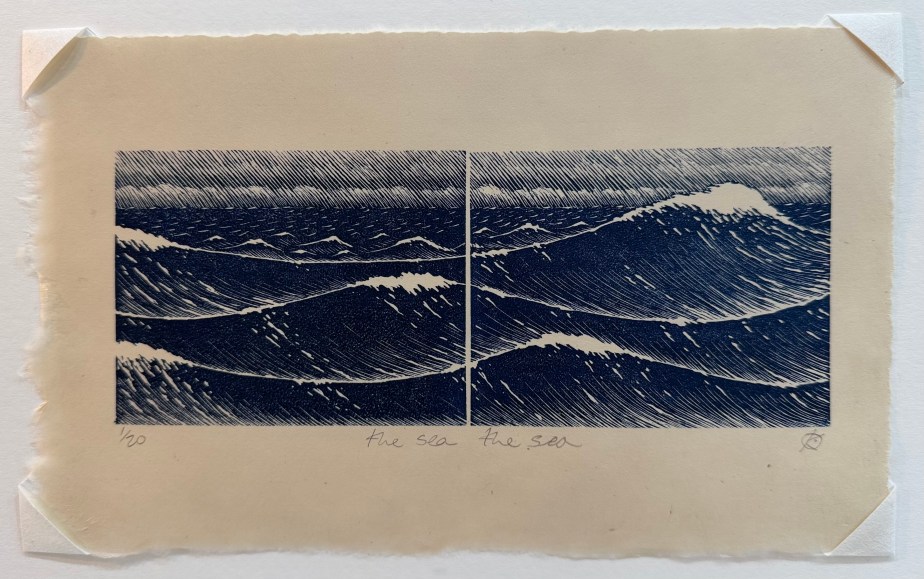
Photo of print showing deckle edges (mounted using washi phot mount corners).
September 2026

